












Man versus Machine: The Biggest Transformation since Henry Ford's Model T
Darryl Judd, Chief Operating Officer, Logistics Executive Group

Darryl Judd, Chief Operating Officer, Logistics Executive Group
According to an Oxford University study in 2013, it was predicted that automation would replace half the workforce in the US alone in the next two decades. The big concern for many today is that the accelerated adoption of automation in the logistics industry will destroy jobs, as technology replaces humans.
This fear is understandable. Transurban’s Scott Charlton at the AFR Business Summit declared that this is only the beginning of a major transformation. New technologies are merging rapidly in all sorts of new ways. “Everyone knows about electronic and autonomous vehicles. But we’ve got intelligent transport systems, Mobile-as-a-Service, and other technologies that are combining now in different ways to fundamentally change transport”. Charlton describes this as the biggest transformation of the transport sector since Henry Ford’s Model T and there is more to come.
Here are a few figures that highlight how staggering this change is:
1. The robot invasion
Populist government is globally exalting protectionist policies to save jobs. However, there is no stopping the robots. The use of robotics will increase in the logistics industry by 15x in the next 4 years, according to a new report by Tractica. It is estimated that this will initiate a staggering extra US$4.44b investment by 2022. According to the report titled "Warehousing and Logistics Robots," there were an estimated 40,000 robotic units shipped worldwide in 2016 but by 2021, there will be 620,000. They predict robotic shipments to reach $22.4 billion by the end of 2021, up from an estimated $1.9 billion in 2016.
 Companies like Amazon and Google are competing to invent advanced warehouse technology. Ford is also experimenting with co-bots (collaborative robots) in a factory in Germany.
2. Rise of the Internet of Things (IoT)
The Global Internet of Things (IoT) market reached USD 598.2 Billion in 2015 and the market is expected to reach USD 724.2 Billion by 2023. Further, the market is projected to register a CAGR of 13.2 percent during the forecast period 2016- 2023 globally, according to Research Nester. In another report, Forrester found that 58 percent to 77 percent of surveyed organizations consider locating objects, containers, and personnel as the top fundamental functions of IoT solutions. If we just look at the retail industry alone, Juniper Research forecasts that by 2020, retailers worldwide will spend $2.5B on IoT-related hardware alone, including beacons, RFID tags, sensors, and their installation costs. This investment represents a nearly fourfold increase from 2015.
3. E-commerce and Omni-Channel Solutions
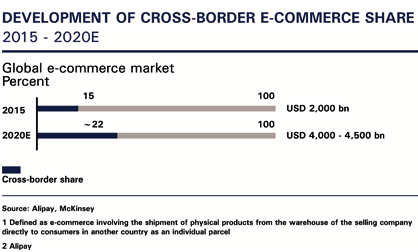
According to a recent report by DHL, the cross-border, e-commerce market accounted for USD 300 billion Gross Merchandise Value (GMV) in 2015. It is expected to grow at a rate of about 25 percent per annum by 2020. This represents unrivalled growth on a global scale with 20 percent of cross-border purchases worth over USD 200.
If we consider China alone, according to the State Council of the People’s Republic of China, in 2016 the country became the largest retail e-market in the world with a value of sales of US$4.886 trillion, compared to US$4.823 trillion in the US. This growth will continue as it is estimated by Alibaba and Accenture that the retail e-commerce market for overseas consumers will reach $994 Billion by 2020.
The biggest transformation in the workplace since Henry Ford’s Model T
This transformation has been painful for many, particularly the low-skilled. However rather than a threat, the addition of automation will likely yield new jobs and opportunities for businesses as they make processes faster, safer and more efficient. As a result, the logistics market will actually grow and its workforce along with it.
Culture of adaptors
To be successful throughout this upheaval, leaders need to bring their people along with them. They need to inspire, to be the front-runners that set precedents, control and at the same time, unleash imagination.
Employees need to upskill and demonstrate geographical flexibility. To have the mental stamina to embrace the endless flux that new waves of technologies will bring and jettison fear of the new. The logistics industry of the future will employ highly skilled professionals in positions that do not exist today. Their willingness and ability to acclimatise and assimilate new technology are critical.
Widening skill gap
To stay competitive, leaders must empower and delegate more. For example, at Amazon, Bezos offers his employees 95 percent prepaid tuition at fulfilment centers in in-demand fields. This encourages them to "be owners from day one," according to Teal Pennebaker, Corporate Communications Manager. By determining their own study choices in this way, Amazon is also allowing staff to take ownership and "pioneer" their own careers.
The new head of Microsoft, Satya Nadella, who has been praised for turning around his company in the last 3 years, agrees that he has had to "listen" more. As opposed to Bill Gates, he encourages open collaboration, similar to Amazon’s empowering training plans. This offers employees the confidence to take risks and exchange ideas.
The bottom line is that automation can enhance the logistics workforce, as long as people are brought along on the journey through good leadership. The adage coined by Doug Conant, President, and CEO of the Campbell Soup Company many years ago, that "to win in the marketplace you must first win in the workplace," rings truer than ever in today’s age of disruption.

